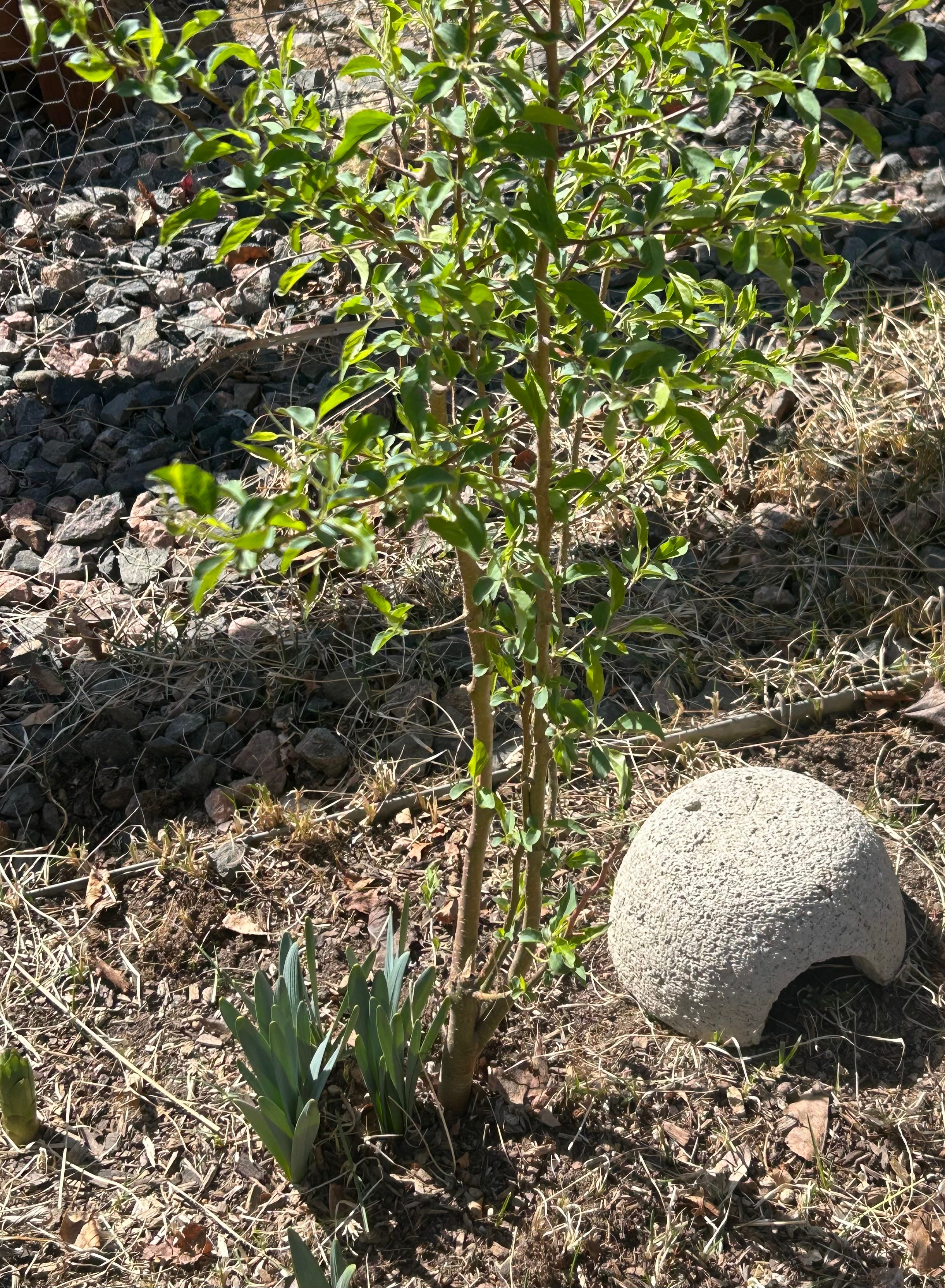
A Mystery Tree
And a water emergency

We are in a water emergency.
All residents got a message from our town’s Director of Utilities, saying that we cannot turn on our irrigation systems, not because of the drought, per se, or new development, but because of “seasonal operational limitations.” In other words, we’ve been hitting record March temps of 85-90 degrees, but we aren’t in our summer water supply yet so if people use the water now, we won’t have it.
It is the latest reminder, in a sea of them, that we (as a collective) are not doing well…and there’s very little I can do to make it better.
So I’m going where I go when things go wrong; circling back to wisdom that’s already been shared, and I found myself sitting with James Baldwin, again. I wrote a huge paper about him in grad school, and started it by saying, “To write about him feels intrusive. What can I, as a young, white, straight, middle class, mother living in 2021 possibly illuminate about him that he did not already illuminate himself?” Some people say he “never forgot or forgave” (America, and white Americans for racism). He, himself, was adamant about not forgiving, at times. But I wonder if forgiveness was actually a constant presence, for him. He wrestled with it, but you can only wrestle with something that’s there.
In The Fire Next Time he said, “there are too many things we do not wish to know about ourselves,” implying that whatever we do not face in ourselves, expands, distorts, and reappears in the world around us. The systems we live in are not separate from us; many are built from the parts of ourselves we refuse to know.
Joan Roshi Halifax, in her Ted Talk on Compassion, quotes a line from the Mahabharata, the great Indian epic: “What is the most wondrous thing in the world, Yudhisthira?” And Yudhisthira replied, “The most wondrous thing in the world is that all around us people can be dying and we don’t realize it can happen to us.” Baldwin in The Fire Next Time said, “Perhaps the whole root of our trouble, the human trouble, is that we will sacrifice all the beauty of our lives, will imprison ourselves in totems, taboos, crosses, blood sacrifices, steeples, mosques, races, armies, flags, nations, in order to deny the fact of death, which is the only fact we have.”
I might not be able to stop wars or fix things, but I have to be willing to see things and in that seeing ask myself: where are my blind spots? And this goes both ways. Am I ignoring the global suffering? Or steeping myself in it and denying myself the beauty? Am I blaming others (those people using water) or deciding to live in it with everyone, thereby letting myself be an active part of the solution?
It is so dry and so brown and at the same time, a mystery tree popped up in our backyard. A mystery tree that is bright green, and doesn’t seem to miss the water at all.
And even though I might remove it, and let it be our Easter tree (thank you squirrel), it’s been (yet another) reminder to notice everything, not just what’s wrong.
I dk y’allllllll, I feel like we’re all spiraling. I wish I had some sort of answer or offering and I don’t. But
I’m grateful for water.
And family.
And safety.
And health.
And homemade lemon poppyseed muffins.
And mystery trees, and Santa squirrels.
And a rejuvenating week with company.
And Nepalese food.
And my kids’ imaginations, which are giving me a little breathing room today.
And many, many, many other things.
Baldwin was a master of holding it all. Our “gratituding” (as my son called it recently), has to live alongside the suffering. Not as a way to escape it, but as a way to stay.
This is where I return, when things feel hard. I have to remind myself, too.